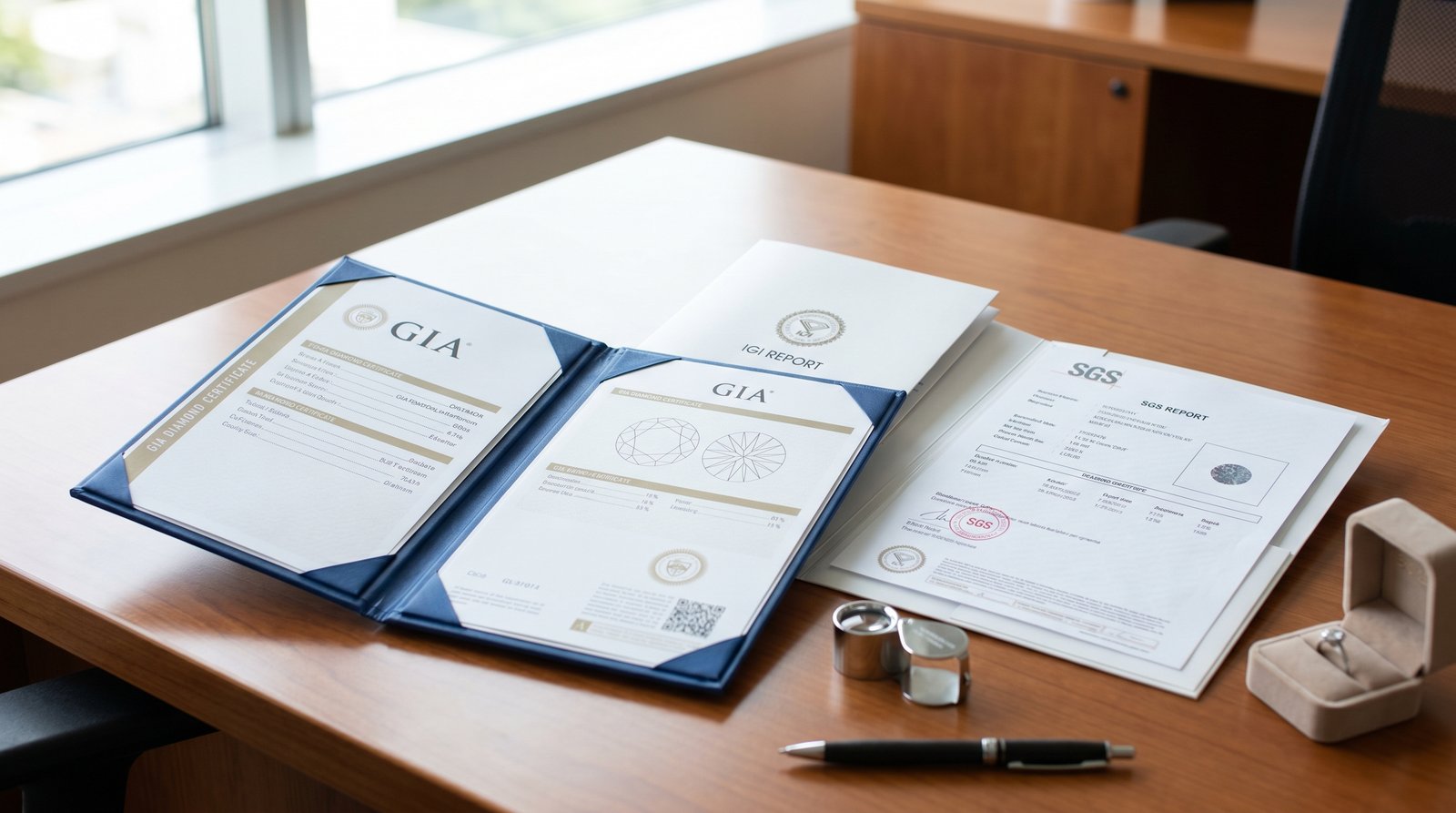
How to Read Jewelry Certifications: SGS, GIA, IGI, GCAL, RJC Explained
Walk into any jewelry trade show, supplier showroom, or B2B sourcing meeting, and you'll be hit with a wall of acronyms: SGS, GIA, IGI, GCAL, GRA, RJC, AGJA, RoHS, REACH. Each one represents a different type of certification, and each serves a different purpose. Understanding which certificates matter for your product — and which are marketing fluff — is essential for protecting your brand and your customers.
This guide breaks down the 8 most commonly cited jewelry certifications, what they actually test, when you need them, and how to verify their authenticity. Whether you're a brand owner evaluating a supplier, a buyer doing QC inspection, or a consumer trying to understand what came in the box with your jewelry, this is the practical reference you've been looking for.
📋 Quick Reference: Which Certification Do You Need?
- Selling fine jewelry with precious metal claims? → SGS (material test) + GIA/IGI (diamond cert)
- Selling fashion jewelry in EU? → REACH + RoHS + nickel-free test
- Selling moissanite jewelry? → GRA moissanite report
- Selling to retailers that require responsible sourcing? → RJC certification of supplier
- Selling in the US with no specific claims? → Internal QC + supplier warranties usually sufficient
1. SGS: The Gold Standard for Material Testing
SGS (Société Générale de Surveillance) is a Swiss-based testing, inspection, and certification company — the world's largest. In the jewelry industry, SGS is best known for material composition testing: verifying that the metal you ordered is actually what the supplier claims.
What SGS Tests
- Metal fineness: Is this 925 silver actually 92.5% silver? Is the 14K gold actually 58.5% gold?
- Plating thickness: Is the rhodium plating at least 0.1 micron? Is the gold plating the claimed thickness?
- Heavy metals: Lead, cadmium, nickel release per REACH and CPSIA standards
- Stone authenticity: XRF testing to confirm CZ vs. diamond, or natural vs. synthetic
What SGS Does NOT Test
- Diamond cut/color/clarity grading (use GIA or IGI for that)
- Manufacturing process or labor practices (use RJC or BSCI for that)
- Hallmark accuracy (that's the assay office, not SGS)
When You Need SGS
For any precious metal claim (sterling silver, gold, platinum), SGS testing is the most reliable way to verify. Most B2B brands require an SGS test report on the first production batch of any new product, then random spot-checks thereafter.
At LY Jewelry, every new design goes through SGS testing during the sampling phase, and we maintain an SGS certification for our entire facility that covers material traceability, plating thickness, and heavy metal compliance.
2. GIA: The World's Most Trusted Diamond Grader
GIA (Gemological Institute of America) is the most recognized diamond grading authority in the world. A GIA certificate is the closest thing to an "industry standard" for loose diamonds and is the most commonly cited certificate in retail jewelry.
What GIA Tests (the 4Cs)
- Carat weight: Exact weight to 0.001ct precision
- Cut: Grades from Excellent to Poor based on light performance
- Color: D (colorless) to Z (light yellow/brown) on a standardized scale
- Clarity: FL (flawless) to I3 (included) based on inclusions under 10x magnification
What GIA Does NOT Test
- Lab-grown diamond origin (GIA does issue separate reports for lab-grown, with specific identification)
- Treatment disclosure (some treatments are noted but not all)
- Country of mining (for natural diamonds)
When You Need GIA
For center stones 0.50ct and above in fine jewelry, GIA is the expected standard. Most US retailers require GIA certification for any center diamond above 0.50ct. For accent diamonds (under 0.20ct), the cost of GIA certification often exceeds the stone's value, so suppliers typically rely on internal documentation.
How to Verify a GIA Report
Every GIA report has a unique report number. Enter it at gia.edu to view the digital version, including a stone diagram showing inclusions. If the report number doesn't exist on GIA's website, the certificate is likely fake.
3. IGI: International Gemological Institute
IGI (International Gemological Institute) is the world's largest independent gem certification lab. IGI is more common in Asian and European markets than GIA, and it's particularly strong in lab-grown diamond and colored stone certification.
IGI vs. GIA
IGI and GIA are roughly comparable in quality, with some industry observers suggesting IGI is slightly more lenient on color and clarity grading. For lab-grown diamonds specifically, IGI is often the preferred certifier because they were early to develop lab-grown-specific grading standards.
When to Choose IGI
- Lab-grown diamonds (IGI is widely accepted in this category)
- Colored gemstones (sapphires, emeralds, rubies)
- European and Asian market sales
- When faster turnaround is needed (IGI is often faster than GIA)
4. GCAL: Gem Certification & Assurance Lab
GCAL is a New York-based gem lab that's gained significant market share since 2020, particularly in lab-grown diamonds. GCAL is known for its rigorous standards and 4Cs grading on the same scale as GIA.
What Makes GCAL Different
- 8X cut grade: A proprietary cut analysis more detailed than GIA's 3-tier cut grade
- Light performance analysis: Reports include actual light return measurements, not just proportions
- Photographed inclusion plots: Actual stone images alongside the diagram
When to Choose GCAL
For premium lab-grown diamonds, GCAL's 8X cut grade is increasingly the standard. Some high-end brands (especially in the US) prefer GCAL for center stones as a "next step up" from IGI.
5. GRA: The Moissanite Certifier
GRA (Gemological Research Association) is the most common certifier for moissanite stones. Unlike diamonds, which have GIA/IGI/GCAL as competing labs, moissanite certification is dominated by GRA (with Charles & Colvard issuing their own reports for their branded moissanite).
What GRA Tests
- Stone authenticity (is this actually moissanite?)
- Approximate carat weight
- Color grade (similar scale to GIA)
- Clarity grade
Controversy Around GRA
GRA has been criticized in some industry circles for less rigorous standards than GIA/IGI. Reports since 2020 are verifiable online at the GRA website, which has helped legitimacy. For most moissanite applications, GRA is the standard certifier and is generally accepted by retailers.
How to Verify a GRA Report
Check the report number at gra-moissanite.org. Pre-2020 reports are often not in the online system, so the report itself is the only verification.
6. RJC: Responsible Jewelry Council
RJC (Responsible Jewelry Council) is not a material or stone certificate — it's a supply chain certification for jewelry manufacturers, retailers, and suppliers. RJC certification verifies that a company follows responsible business practices across human rights, labor, environmental impact, and product disclosure.
What RJC Certification Covers
- Human rights: No child labor, forced labor, or human trafficking
- Labor rights: Fair wages, safe working conditions, freedom of association
- Environmental impact: Waste management, chemical handling, emissions
- Product disclosure: Accurate representation of materials and sourcing
- Responsible sourcing: Due diligence on gold, diamonds, and colored stones from conflict-affected areas
When You Need RJC
Many large retailers (Signet, Pandora, Tiffany & Co., major US department stores) now require RJC certification from their suppliers. If you're selling to these retailers, RJC is mandatory. For smaller brands, RJC is increasingly seen as a competitive advantage, especially with ESG-conscious consumers.
RJC vs. AGJA
AGJA (Asian Gem & Jewelry Association) is the regional equivalent in Asia, with similar standards and a strong presence in Thailand. Many Thai manufacturers hold both RJC and AGJA certifications.
7. RoHS and REACH: The EU Compliance Duo
These are not jewelry-specific certifications — they're EU chemical safety regulations that apply to all consumer products, including jewelry.
RoHS (Restriction of Hazardous Substances)
Restricts lead, cadmium, mercury, hexavalent chromium, and certain flame retardants in electrical products. While jewelry is generally exempt, components with electrical elements (LED jewelry, smart jewelry) must comply. Many brands also test non-electrical jewelry to RoHS standards as a quality signal.
REACH (Registration, Evaluation, Authorisation and Restriction of Chemicals)
EU's broad chemical safety regulation. For jewelry, the key requirements are nickel release (must be below 0.2 μg/cm²/week for items in direct/prolonged contact with skin) and restrictions on lead and cadmium. REACH compliance is essential for selling jewelry in the EU.
When You Need RoHS / REACH
If you sell to EU customers (including via your own e-commerce site shipping from outside the EU), you must comply with REACH nickel-release limits. Many US and Asian brands voluntarily test to these standards to access the EU market.
8. CPSIA: The US Consumer Product Safety Standard
CPSIA (Consumer Product Safety Improvement Act) is the US federal regulation for children's products, including children's jewelry. It sets strict limits on lead content (300 ppm total, 100 ppm in accessible substrate) and requires third-party testing for children's jewelry.
When You Need CPSIA
Any jewelry marketed to or primarily used by children under 12. CPSIA compliance testing is non-negotiable for children's jewelry sold in the US — failure can result in product recalls and significant fines.
Certification Quick Reference Table
| Cert | What It Tests | When You Need It | Cost Range |
|---|---|---|---|
| SGS | Material composition, plating, heavy metals | All precious metal claims | $100-500 per test |
| GIA | Diamond 4Cs grading | Center diamonds 0.50ct+ | $50-150 per stone |
| IGI | Diamond 4Cs + lab-grown cert | Lab-grown diamonds, colored stones | $30-100 per stone |
| GCAL | 8X cut grade, light performance | Premium lab-grown diamonds | $50-200 per stone |
| GRA | Moissanite authenticity and grade | Moissanite jewelry | $10-50 per stone |
| RJC | Supply chain responsibility | Major retailer sales, ESG claims | Annual supplier fee |
| RoHS / REACH | EU chemical safety | EU market sales | $200-800 per test |
| CPSIA | US children's product safety | Children's jewelry (US) | $300-1000 per test |
How to Spot Fake Certificates
Counterfeit certificates are unfortunately common, especially for GIA and GRA. Here's how to verify:
- Check the report number online — Every GIA, IGI, GCAL, and modern GRA report has a unique number searchable on the lab's website. If it doesn't exist, it's fake.
- Look for security features — Holograms, security paper, microprinting, and specific fonts. GIA reports have a hologram in the lower right corner.
- Verify the report matches the stone — Compare the stone's dimensions, weight, and inclusions to the report. A 1.00ct round brilliant cannot have the proportions of a 0.50ct marquise.
- Use a third-party verification service — For high-value stones, services like StoneAlgo and RapNet provide independent verification.
- Buy from certified suppliers — RJC-certified suppliers (like LY Jewelry) are required to maintain chain of custody for all certified stones.
Need a Certification Strategy for Your Brand?
Tell us your product mix and target markets. We'll recommend the right certification portfolio and provide cost estimates. We supply GIA, IGI, GCAL, GRA, and SGS-certified jewelry with full chain-of-custody documentation.
Get Certification Strategy →Frequently Asked Questions
Are GRA moissanite certificates real?
GRA (Gemological Research Association) is a real organization that issues moissanite grading reports. However, GRA is not as widely recognized or rigorous as GIA or IGI for diamond grading. For moissanite specifically, GRA is the most common certifier. To verify a GRA report, check the report number on the GRA website — most reports since 2020 are verifiable online.
Do I need an SGS certificate for every shipment?
Not necessarily. Most B2B brands require an SGS test on the first production batch of a new product, then random spot-checks on subsequent batches (typically 1 in 5-10 batches). For low-risk fashion jewelry, some brands skip SGS entirely and rely on the supplier's internal QC. For fine jewelry with precious metal claims, SGS is strongly recommended.
Is GIA grading worth the cost for small stones?
Generally no. GIA diamond grading costs $50-150+ per stone for melee (small stones under 0.20ct). For accent diamonds under 0.10ct, the grading cost can exceed the stone's value. Most brands use GIA for center stones (0.50ct+) and rely on supplier documentation for melee. For very small accent stones, an IGI or GCAL 'screening' report is more cost-effective than full GIA grading.
What's the difference between RJC and AGJA?
Both are supply chain responsibility certifications. RJC (Responsible Jewelry Council) is global, headquartered in London, and recognized by major Western retailers. AGJA (Asian Gem & Jewelry Association) is regional to Asia, with strong presence in Thailand. Standards are broadly comparable, and many Thai manufacturers (including LY Jewelry) hold both. For sales to large Western retailers, RJC is typically required.
Manufacturer of sterling silver and gold jewelry for B2B brands worldwide. 25 years of OEM/ODM experience. SGS-certified. AGJA member. Trusted by 5,000+ jewelry professionals across 24 countries.