Why Thailand Beats China: The 2026 Tariff Reality for US Jewelry Importers
📌 TL;DR
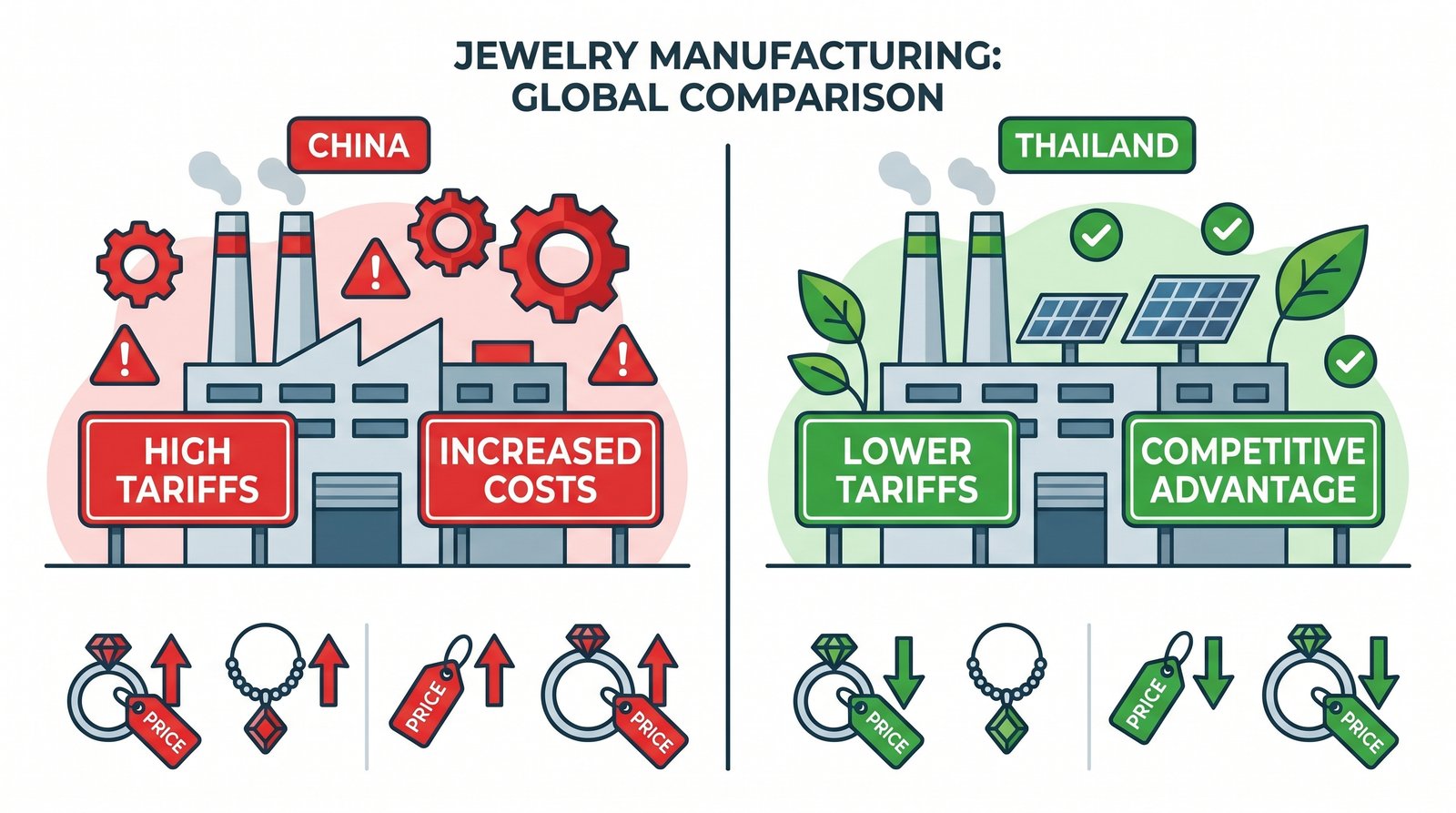
For US jewelry importers, Thailand-origin goods face 19% IEEPA reciprocal tariff + MFN base rate, while China-origin goods face 50-90% combined duties (MFN + Section 301 + IEEPA). For a $100,000 annual order, switching from China to Thailand saves $18,000-$36,000 in landed cost. A Certificate of Origin from the Thai Ministry of Commerce is the critical document that unlocks this advantage.
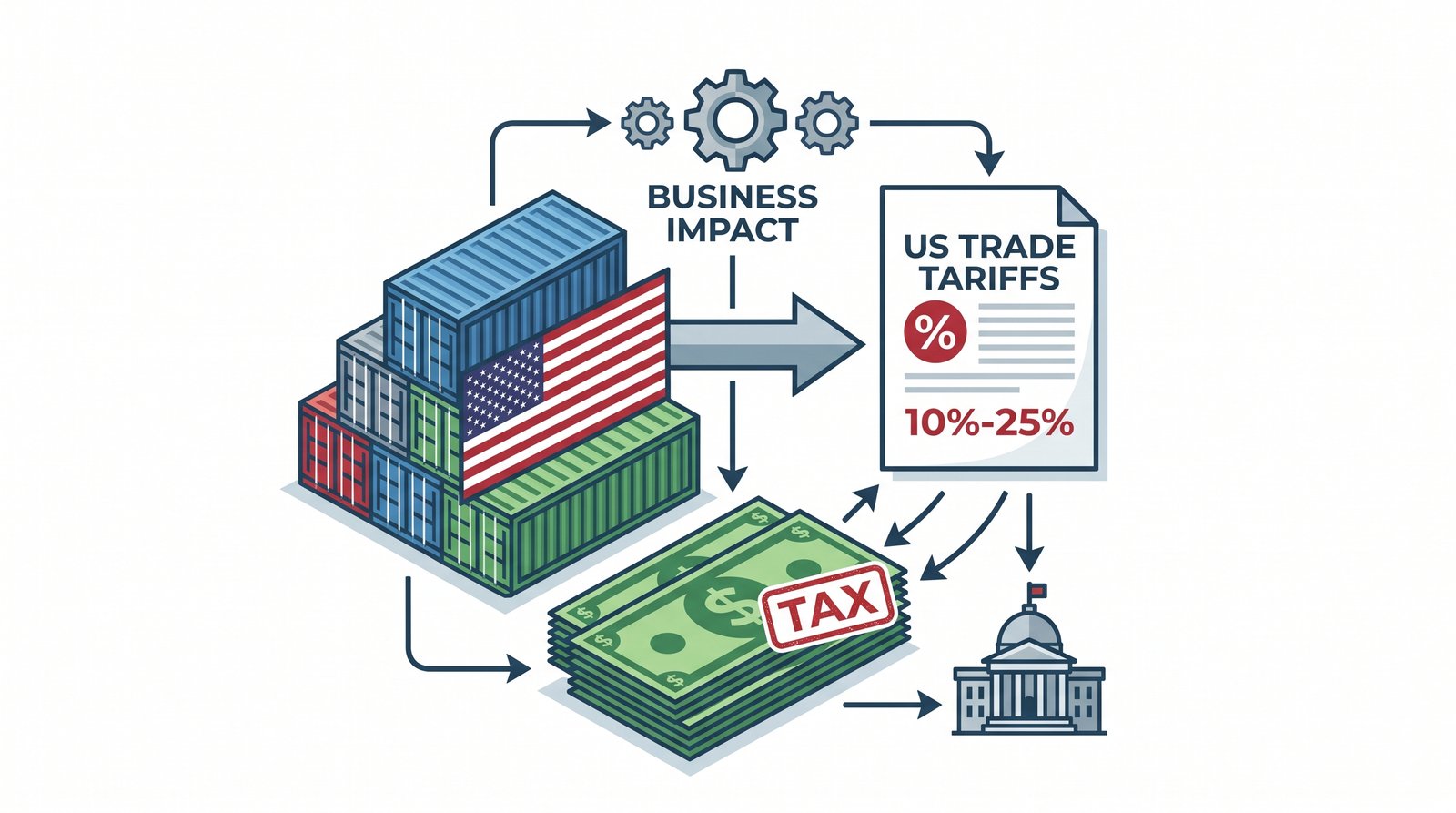
If you're sourcing jewelry from China and reselling into the United States, 2025-2026 has likely been the most disruptive tariff period in your career. The IEEPA reciprocal tariffs introduced in April 2025, the reinstatement of Section 301 List 4A in February 2025, and the ongoing Section 232 derivatives investigation have collectively raised the combined duty burden on Chinese jewelry to levels that are simply uneconomic for most B2B importers.
Meanwhile, Thailand — long an "almost-but-not-quite" alternative to China for jewelry manufacturing — has emerged as the clear winner. This article breaks down exactly why, with real numbers.
The 2026 Tariff Stack: A Quick Refresher
US import tariffs aren't a single number — they're a stack of independent duties that apply cumulatively. For jewelry, the relevant stack is:
1. MFN Base Rate (Column 1 General)
The baseline duty every country pays, set by the WTO. For jewelry, this ranges from 5.5% to 13.5% depending on the HTS code (7113 for precious metal jewelry, 7117 for imitation jewelry, 7116 for articles of natural/cultured pearls).
2. Section 301 (China-Specific, 2018-)
Added by USTR under the Trade Act of 1974 to counter China's IP practices. Most jewelry categories face 7.5% to 25% under various lists. List 4A, which was paused in 2019, was fully reinstated in February 2025 at the original 7.5%-25% rates. This is the most commonly cited "China tariff."
3. IEEPA Reciprocal Tariff (2025-)
Imposed under the International Emergency Economic Powers Act, this is the "reciprocal" tariff designed to match the trade barriers other countries allegedly impose on US goods. Rates are country-specific and have been revised multiple times:
- China: 20% (initially higher, negotiated down)
- Thailand: 19%
- India: 25%
- Vietnam: 20%
4. Section 232 (Steel/Aluminum Derivatives)
Originally applied to raw steel and aluminum, this was expanded in 2025 to include "derivatives" — which the USTR has indicated includes certain jewelry components with metal content. Most sterling silver and gold jewelry is not currently on the Section 232 derivatives list, but the USTR has signaled this may expand. This is a watch-this-space item.
The Numbers: China vs. Thailand on a $100K Order
Let's run the math on a representative order: $100,000 of sterling silver fashion jewelry (HTS 7113.11), FOB Bangkok/Shenzhen. We'll assume air freight + 5% duty + freight insurance.
| Component | China Origin | Thailand Origin |
|---|---|---|
| FOB price | $100,000 | $100,000 |
| MFN base (7113.11 = 5.5%) | $5,500 | $5,500 |
| Section 301 (List 4A, ~10% for this category) | $10,000 | $0 (not applicable) |
| IEEPA reciprocal (20% China / 19% Thailand) | $20,000 | $19,000 |
| Total duty | $35,500 | $24,500 |
| Landed cost | $135,500 | $124,500 |
Savings: $11,000 on a $100K order = 11% landed cost advantage.
But that's just the baseline scenario. For some categories, the gap is much wider:
| HTS Code / Category | China Total Duty | Thailand Total Duty | Savings |
|---|---|---|---|
| 7113.11 — Sterling silver necklaces | ~35% | ~25% | 10% |
| 7113.19 — Other sterling silver articles | ~45% | ~25% | 20% |
| 7117.11 — Cufflinks and studs | ~50% | ~30% | 20% |
| 7117.19 — Other imitation jewelry (with metal) | ~90% | ~30% | 60% |
| 7116 — Articles of precious/semi-precious stones | ~40% | ~25% | 15% |
For fashion jewelry with mixed materials (7117.19 — the largest category by volume), the combined duty on Chinese goods can reach 90%+. On that same $100K order, the savings from Thailand sourcing would be $60,000+.
The Certificate of Origin: Your Most Important Import Document
The single most important document in this entire discussion is the Certificate of Origin (CO). Issued by the Thai Ministry of Commerce's Foreign Trade Department, this official document certifies that your goods were substantially produced or transformed in Thailand.

Without a CO, US Customs defaults to the highest applicable rate — and may apply both Section 301 (if they suspect China-origin content) and IEEPA at the higher China rate. A CO is non-negotiable.
Here's how the CO process works at LY Jewelry:
- Your order is manufactured in our Bangkok facility using Thai-sourced metal (when available) and Thai labor
- Pre-shipment, we apply to the Thai Ministry of Commerce for a Certificate of Origin
- The Ministry reviews production records, bills of materials, and value-add calculations
- Once approved (typically 3-5 business days), the CO is issued and travels with the shipment
- Your US customs broker files the CO with your entry, and the Thailand tariff rate is applied
The CO is the only document that unlocks the 19% vs 20% (or higher) differential. Without it, all the manufacturing in the world doesn't matter — US Customs will treat your goods as China-origin if the value chain suggests it.
Beyond Tariff: The Other Reasons Brands Are Switching to Thailand
The tariff story is dramatic, but it's not the only reason brands are moving production from China to Thailand. Other factors include:
1. AGJA Certification
The Asian Gem & Jewelry Association (AGJA) certifies Thai jewelry manufacturers for ethical labor, environmental compliance, and quality systems. AGJA-certified factories (including LY Jewelry) can host B2B clients for factory visits and provide documentation that satisfies most retailers' ESG requirements. China has no equivalent certification with comparable international recognition.
2. Communication & Cultural Fit
Thailand's jewelry workforce is largely Thai-speaking and English-speaking at the management level. Compared to Chinese factories (where communication often requires a bilingual intermediary), this reduces miscommunication, speeds problem-solving, and lowers the cost of relationship management.
3. IP Protection
While Thailand is not perfect on IP, its enforcement has improved dramatically. The Thai Department of Intellectual Property has a dedicated jewelry IP unit. Several brands that experienced design theft in Chinese factories report zero IP issues after switching to Thailand.
4. Logistics & Lead Time
Bangkok's Suvarnabhumi Airport is a major cargo hub with direct flights to LAX, JFK, ORD, and most major US destinations. Total air transit from Bangkok to most US East Coast destinations is 22-28 hours — comparable to Shenzhen. Sea freight from Laem Chabang to Long Beach is 18-22 days.
The Caveats: When China Still Makes Sense
To be fair, China remains the right choice for some categories:
- Very high-volume, low-complexity pieces (under $5 retail) where mainland Chinese factories' scale economics still beat Thailand
- Specialized techniques (e.g., sophisticated enamel work, certain types of filigree) where the supplier base in Thailand is limited
- Pieces that genuinely require both Chinese components and Thai finishing — in which case, talk to us about our dual-factory model (JingZhi in Guangzhou for precision casting + LAIYI in Bangkok for finishing)
The Bottom Line
If you're importing B2B jewelry into the United States, the 2026 tariff environment has made the Thailand-sourcing math extremely compelling. The combination of lower duty rates, AGJA certification, IP protection, and good logistics makes Thailand the new default for serious jewelry brands — and Chinese sourcing the special case that requires explicit justification.
For a free landed-cost analysis on your specific product mix, contact us with your current HTS codes and we'll model both scenarios. Most brands see ROI on the switch within 4-8 months.
Get a Free Tariff Comparison for Your Product Mix
Send us your current HTS codes and product specs. We'll model China vs. Thailand landed costs for your specific order. No commitment.
Request Comparison →Frequently Asked Questions
What is the current tariff on Chinese jewelry into the US?
As of mid-2026, jewelry (HTS 7113 and 7117) imported from mainland China faces a combined tariff of 50-90% depending on metal composition: 5.5-13.5% MFN base + 7.5-25% Section 301 + 20% IEEPA reciprocal. For some categories like fashion jewelry with mixed materials, total duties can exceed 90%.
What is Thailand's tariff rate for jewelry into the US?
Thailand-origin jewelry currently faces a 19% IEEPA reciprocal tariff in addition to MFN base rates. With a Certificate of Origin from the Thai Ministry of Commerce, no Section 301 duties apply (these are China-specific). Total effective duty is typically 19-27% for most categories.
What is a Certificate of Origin and why does it matter?
A Certificate of Origin (CO) is an official document issued by the exporting country's government certifying that goods were substantially produced or transformed in that country. For US imports, a Thai CO from the Ministry of Commerce qualifies jewelry for Thailand's reciprocal tariff rate (19%) instead of China's (20%+). Without a CO, customs defaults to the highest applicable rate.
Is the tariff savings worth switching from China to Thailand?
For most B2B jewelry importers, yes. On a $100,000 annual order, the savings range from $18,000 to $36,000. Over a 3-year relationship, that's $54,000-$108,000 in additional margin. The transition cost (qualifying a new supplier, tooling up) typically pays back in 4-8 months for established brands.
What about Section 232 — will jewelry be included?
The USTR has indicated Section 232 may be expanded to include "derivatives" of steel and aluminum, which could include certain jewelry components. As of June 2026, finished jewelry (HTS 7113, 7117) is not on the Section 232 derivatives list. We monitor this monthly and will update this article if status changes.

Manufacturer of sterling silver and gold jewelry for B2B brands worldwide. 25 years of OEM/ODM experience. SGS-certified. AGJA member. Trusted by 5,000+ jewelry professionals across 24 countries.